 Zach Corleissen
abcee2dccd
Zach Corleissen
abcee2dccd
* Update localization guidelines for language labels

Continuing work

Continuing work

Continuing work

More work in progress

Add local OWNERS folders

Add an OWNERS file to Chinese

Remove shortcode for repos

Add Japanese

Alphabetize languages, change weights accordingly

More updates

Add Korean in Korean

Add English to languageName

Feedback from gochist

Move Chinese content from cn/ to zh/

Move OWNERS from cn/ to zh/

Resolve merge conflicts by updating from master

Add files back in to prep for resolution

After rebase on upstream/master, remove files

Review and update localization guidelines

Feedback from gochist, tnir, cstoku

Add a trailing newline to content/ja/OWNERS

Add a trailing newline to content/zh/OWNERS

Drop requirement for GH repo project

Clarify language about forks/branches

Edits and typos

Remove a shortcode specific to a multi-repo language setup

Update aliases and owners

Add explicit OWNERS for content/en

Migrate content from Chinese repo, update regex in config.toml

Remove untranslated strings

Add trailing newline to content/en/OWNERS

Add trailing newlines to OWNERS files

add Jaguar project description (#10433)

* add Jaguar project description

[Jaguar](https://gitlab.com/sdnlab/jaguar) is an open source solution for Kubernetes's network based on OpenDaylight.
Jaguar provides overlay network using vxlan and Jaguar CNIPlugin provides one IP address per pod.

* Minor newline tweak

blog post for azure vmss (#10538)

Add microk8s to pick-right-solution.md (#10542)

* Add microk8s to pick-right-solution.md

Microk8s is a single-command installation of upstream Kubernetes on any Linux and should be included in the list of local-machine solutions.

* capitalized Istio

Add microk8s to foundational.md (#10543)

* Add microk8s to foundational.md

Adding microk8s as credible and stable alternative to get started with Kubernetes on a local machine. This is especially attractive for those not wanting to incur the overhead of running a VM for a local cluster.

* Update foundational.md

Thank you for your suggestions! LMK if this works now?

* Rewrote first paragraph

And included a bullet list of features of microk8s

* Copyedit

fix typo (#10545)

Fix the kubectl subcommands links. (#10550)

Signed-off-by: William Zhang <warmchang@outlook.com>

Fix command issue (#10515)

Signed-off-by: mooncake <xcoder@tenxcloud.com>

remove imported community files per issue 10184 (#10501)

networking.md: Markdown fix (#10498)

Fix front matter, federation command-line tools (#10500)

Clean up glossary entry (#10399)

update slack link (#10536)

typo in StatefulSet docs (#10558)

fix discription about horizontal pod autoscale (#10557)

Remove redundant symbols (#10556)

Fix issue #10520 (#10554)

Signed-off-by: William Zhang <warmchang@outlook.com>

Update api-concepts.md (#10534)

Revert "Fix command issue (#10515)"

This reverts commit c02a7fb9f9.

Update memory-constraint-namespace.md (#10530)

update memory request to 100MiB corresponding the yaml content

Blog: Introducing Volume Snapshot Alpha for Kubernetes (#10562)

* blog post for azure vmss

* snapshot blog post

Resolve merge conflicts in OWNERS*

Minor typo fix (#10567)

Not sure what's supposed to be here, proposing removing it.

* Feedback from gochist

Tweaks to feedback

* Feedback from ClaudiaJKang
5.9 KiB
5.9 KiB
title, date, slug, url
| title | date | slug | url |
|---|---|---|---|
| Principles of Container-based Application Design | 2018-03-15 | principles-of-container-app-design | /blog/2018/03/Principles-Of-Container-App-Design |
现如今,几乎所有的的应用程序都可以在容器中运行。但创建云原生应用,通过诸如 Kubernetes 的云原生平台更有效地自动化运行、管理容器化的应用却需要额外的工作。 云原生应用需要考虑故障;即使是在底层架构发生故障时也需要可靠地运行。 为了提供这样的功能,像 Kubernetes 这样的云原生平台需要向运行的应用程序强加一些契约和约束。 这些契约确保应用可以在符合某些约束的条件下运行,从而使得平台可以自动化应用管理。
我已经为容器化应用如何之为云原生应用概括出了七项原则。
| ----- |
| 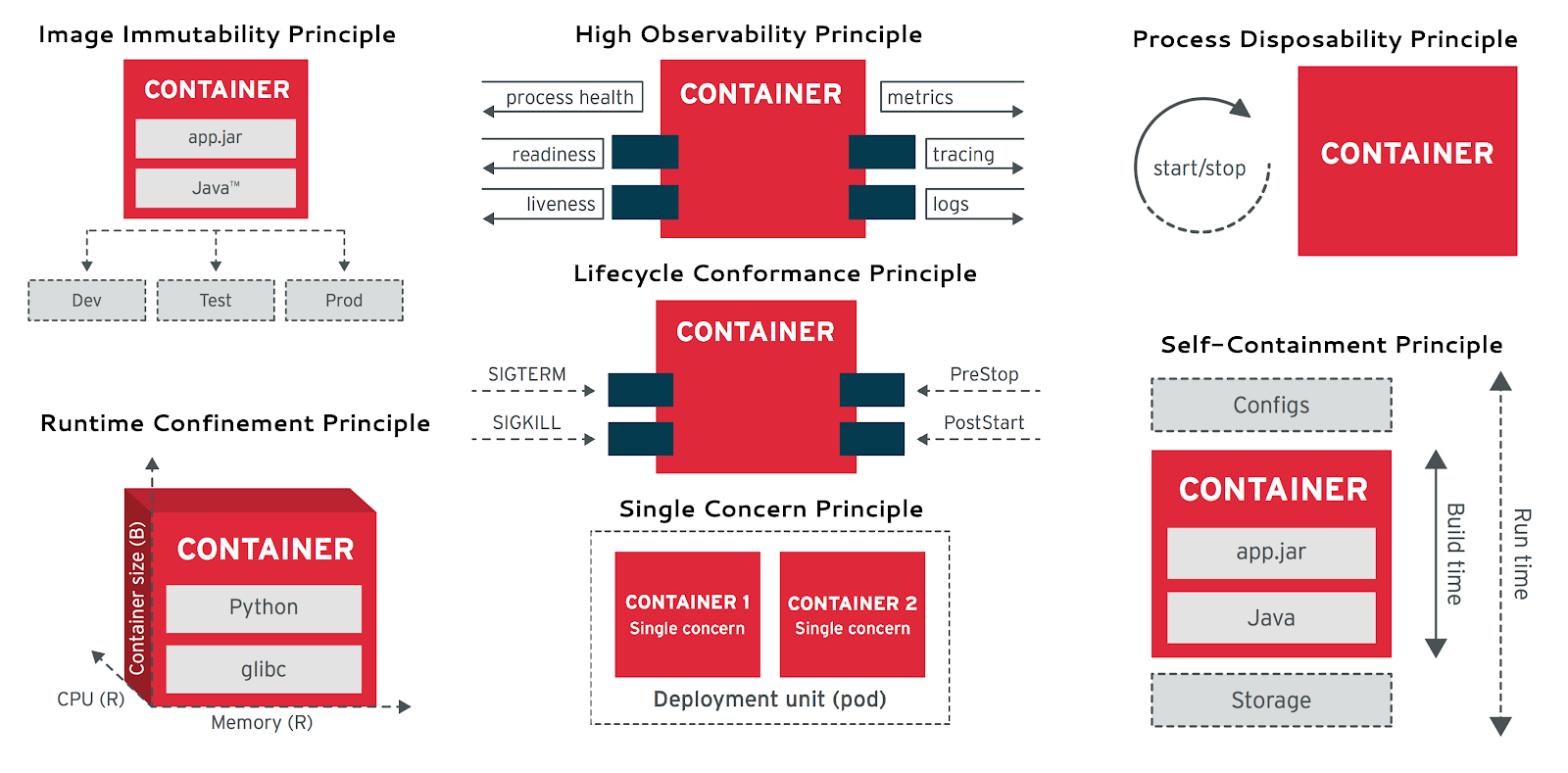
这里所述的七项原则涉及到构建时和运行时,两类关注点。
构建时
- 单一关注点: 每个容器只解决一个关注点,并且完成的很好。
- 自包含: 一个容器只依赖Linux内核。额外的库要求可以在构建容器时加入。
- 镜像不变性: 容器化的应用意味着不变性,一旦构建完成,不需要根据环境的不同而重新构建。
运行时
- 高可观测性: 每个容器必须实现所有必要的 API 来帮助平台以最好的方式来观测、管理应用。
- 生命周期一致性: 一个容器必须要能从平台中获取事件信息,并作出相应的反应。
- 进程易处理性: 容器化应用的寿命一定要尽可能的短暂,这样,可以随时被另一个容器所替换。
- 运行时限制: 每个容器都必须要声明自己的资源需求,并将资源使用限制在所需要的范围之内。
编译时原则保证了容器拥有合适的粒度,一致性以及结构。运行时原则明确了容器化必须要实现那些功能才能成为云原生函数。遵循这些原则可以帮助你的应用适应 Kubernetes 上的自动化。
白皮书可以免费下载:
想要了解更多关于如何面向 Kubernetes 设计云原生应用,可以看看我的 Kubernetes 模式 一书。
— Bilgin Ibryam, 首席架构师, Red Hat
Twitter: Blog: http://www.ofbizian.com Linkedin:
Bilgin Ibryam (@bibryam) 是 Red Hat 的一名首席架构师, ASF 的开源贡献者,博主,作者以及演讲者。 他是 Camel 设计模式、 Kubernetes 模式的作者。在他的日常生活中,他非常享受指导、培训以及帮助各个团队更加成功地使用分布式系统、微服务、容器,以及云原生应用。